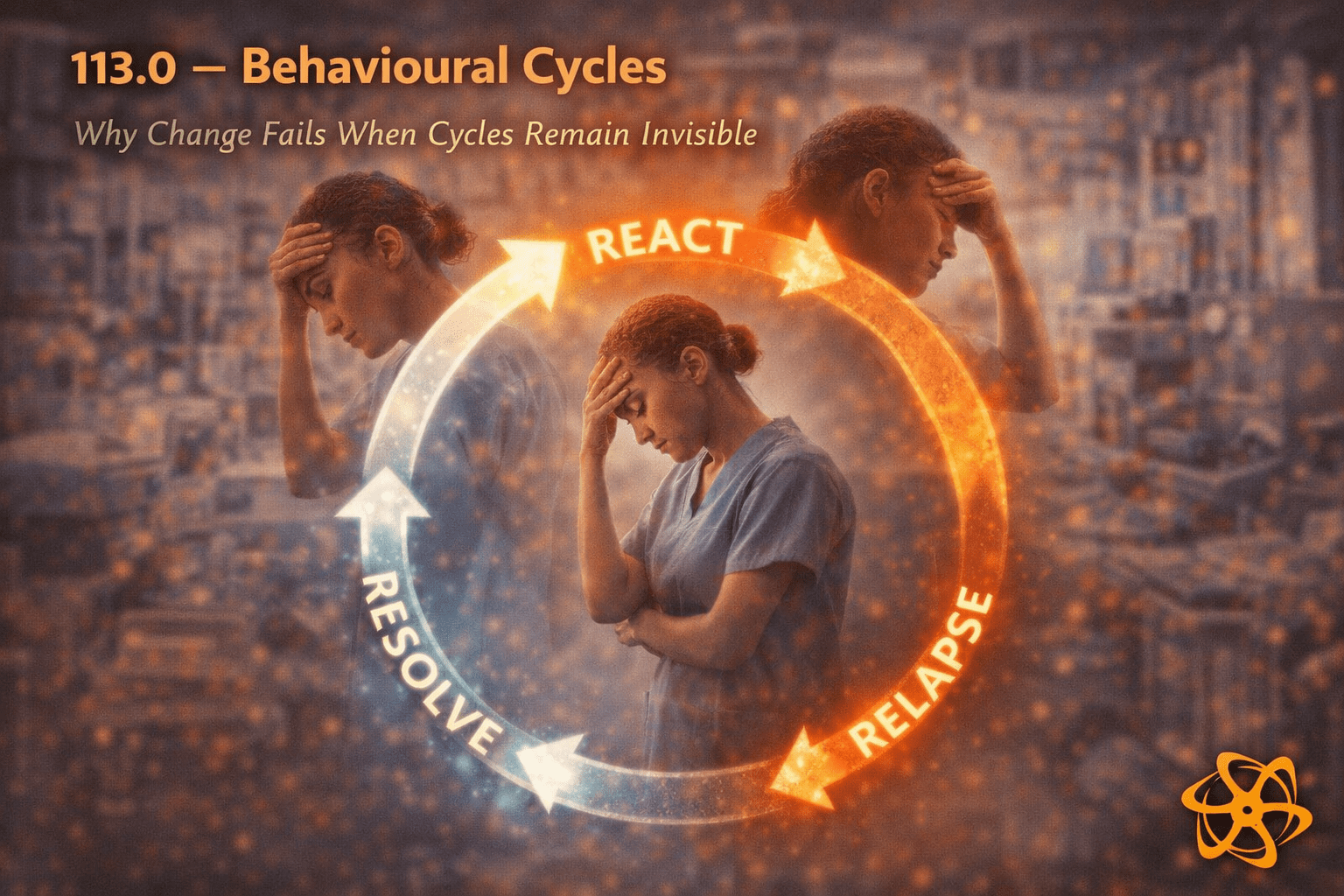
Why Change Fails When Cycles Remain Invisible
Behavioural cycles matter because effort is far removed from interruption, and especially because most unwanted behaviours are not isolated actions but self-reinforcing loops.
In coaching, behaviour is often addressed as a single event: do less of this, do more of that. When cycles are ignored, behaviour returns — sometimes stronger than before. Change stabilises only when the cycle itself is understood.
This post maps how behavioural cycles form and how coaching disrupts them safely.
1. What Behavioural Cycles Actually Are
Behavioural cycles are repeating loops consisting of:
- trigger
- emotional response
- interpretation
- action
- consequence
The consequence feeds the next trigger.
The cycle closes — and repeats.
2. Why Behaviour Repeats Despite Insight
Insight alone does not interrupt cycles.
Cycles persist because:
- emotional drivers remain active
- identity is reinforced
- short-term relief is rewarded
The system learns repetition, not resolution.
3. The Relief Trap
Many cycles are maintained by relief.
For example:
- avoidance reduces anxiety
- overworking reduces guilt
- pleasing others reduces conflict
Relief teaches the system to repeat the behaviour.
Short-term relief creates long-term stagnation.
4. How Behavioural Cycles Hide
Cycles often hide behind:
- rational explanations
- productivity
- responsibility
- “just how things are”
Because outcomes look functional, the cycle goes unexamined.
5. Coaching the Cycle, Not the Behaviour
Effective coaching:
- maps the full loop
- identifies emotional payoffs
- locates identity reinforcement
The question shifts from:
- “Why did you do that?”to
- “What does this cycle give you?”
Awareness disrupts automation.
6. Where to Intervene in a Cycle
Cycles can be interrupted at multiple points:
- reducing trigger exposure
- regulating emotional response
- questioning interpretation
- redesigning action
- altering consequences
The smallest viable intervention is often the most effective.
7. Why Forcing Change Strengthens Cycles
Forcing behaviour change:
- increases emotional charge
- reinforces identity threat
- drives the cycle underground
Pressure strengthens loops.
Safety weakens them.
8. From Cycle to Choice
When cycles are seen:
- predictability replaces confusion
- choice replaces compulsion
- new responses become possible
The cycle loosens because awareness has entered the loop.
In Essence
Behaviour does not repeat because people are weak.
It repeats because cycles are efficient.
Coaching creates change by revealing the loop — and gently interrupting it.
Key Learning Points (KLPs)
- Behavioural cycles are self-reinforcing loops
- Insight alone does not interrupt cycles
- Relief often maintains repetition
- Cycles hide behind functional outcomes
- Coaching targets the cycle, not the act
- Small interventions disrupt large loops
- Awareness restores choice
Action Points (APs)
- Map a recurring behaviour as a full cycle
- Identify the emotional payoff
- Experiment with interrupting one stage
Keywords
behavioural cycles, habit loops, applied wholeness, coaching judgement, behaviour change patterns, emotional reinforcement, sustainable change, Enasni Connections