
From Individuals to Organisations
Wholeness refuses to be linked to personal only. It is also cultural.
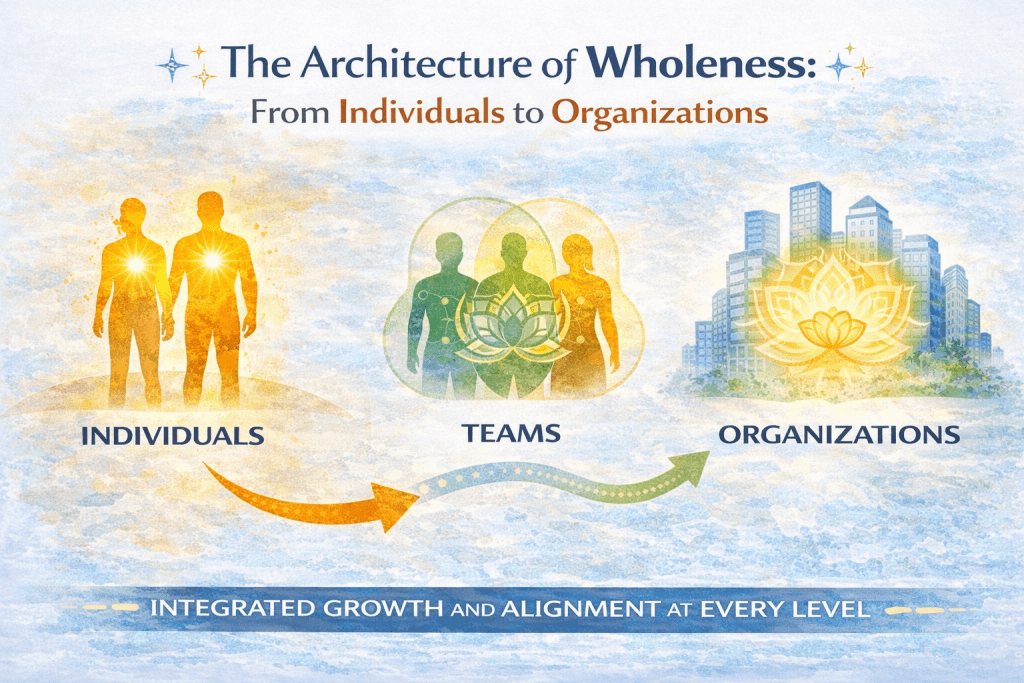
The architecture of wholeness extends beyond the individual. Wholeness refuses to remain personal only — it is also cultural, relational, and systemic.
When a group, organisation, or society begins to function with awareness and intention, the same balance that transforms individuals begins to shape systems. The architecture of wholeness explains how aligned individuals create resilient teams, healthy cultures, and organisations capable of sustaining pressure without fragmentation.
At Enasni Connections, coaching functions as a bridge linking human insight with collective progress. Through the architecture of wholeness, individual awareness becomes organisational stability and shared clarity.
Internal alignment therefore scales outward. Systems become healthier when fragmented pieces reconnect and begin operating again from a wholeness perspective.
In this way, the architecture of wholeness becomes a blueprint for sustainable teams, resilient organisations, and cultures capable of adapting without losing coherence.
1. Within Teams: The Hospital Unit That Found Its Rhythm
A mid-sized hospital unit struggled with exhaustion. Staff turnover was rising, and the word “burnout” had become background noise — a pattern widely documented in healthcare workforce research reported by the World Health Organization. Group coaching was introduced — away from performance management, and towards simple reflection time.
Each nurse began by naming one small change that would improve their shift experience.
One started a five-minute handover pause to breathe before seeing the next patient. Another scheduled time for debriefs after emergencies.
Within months, communication softened. Rotas became fairer. The unit began to function like an organism instead of a collection of parts.
Coaching did more than just improve morale — it restored connection and revealed the architecture of wholeness already present within the team..
In many cases, the early signals of strain resemble the patterns explored in Stress as Information: Listening Before It Breaks You, where pressure first appears as subtle signals rather than crisis.
When those signals are recognised, teams can begin rebuilding the deeper alignment described in Wholeness: The Silent Core of Growth, the organisational expression of the architecture of wholeness in action.
2. Across Organisations: The Tech Company That Learned to Listen
A digital health startup was growing fast, but tension between creative and compliance teams was choking progress.
Through group coaching sessions, the focus shifted from “winning arguments” to understanding motivations — a process similar to the reflective questioning explored in The GROW Model and the Art of Flexibility. As teams clarified what truly mattered, conversations also began aligning with the deeper purpose described in Crafting Your Coaching Mission and Vision as a Great Coach.
Developers admitted they feared stagnation. Legal teams feared liability. Both wanted impact.
The company adopted a reflective meeting structure: every major project began with ten minutes of shared intent — why this matters, what balance is needed.
Conflict did not vanish. It kept evolving into dialogue — a shift widely recognised in organisational psychology research on psychologically safe teams described by Harvard Business School. Productivity also rose, and more importantly, respect returned.
That’s organisational wholeness in practice — structure aligned with humanity.
3. Within Society: Communities as Living Systems
Society mirrors the individuals who compose it — tired, reactive, yearning for connection. Coaching at scale means teaching communities how to listen, reflect, and act with shared purpose.
This reflects the deeper principles explored earlier in the series, particularly in What Is Coaching and in How Coaching Differs From Other Support Disciplines, where structured reflection becomes a tool for sustainable change rather than short-term reaction.
Imagine:
- Schools training students in emotional regulation and reflective questioning.
- Councils holding community “pause circles” to assess impact before policy.
- Neighbourhood initiatives designed not around speed, but sustainability — practical expressions of the architecture of wholeness emerging within communities..
Wholeness in society begins with a single collective question: –
What do we value enough to protect together?
Community development research, including work highlighted by the United Nations on sustainable communities, shows that shared reflection often precedes lasting societal change.
Key Learning Points
- Coaching principles scale beyond individuals — they strengthen the emotional and ethical fabric of teams and organisations.
- Reflective practice can transform professional burnout into collective awareness.
- When systems prioritise balance, communication, and mutual respect, performance naturally follows.
- Society thrives when reflection and responsibility become shared norms.
- Wholeness is less about the absence of struggle — it is more about the presence of coherence.
Action Points
- Introduce coaching-style reflection into real-time team or departmental meetings.
- Encourage leadership to model vulnerability and curiosity rather than control.
- Use organisational stress points as feedback, not failure.
- Create spaces in communities for slow conversation and shared reflection.
In Essence
Wholeness expands through practice.
It starts in one person’s breath, moves through a team’s rhythm, and eventually reshapes the culture of a community.
At Enasni, we believe the health of a system can be measured by how well it listens — to itself, to its people, to its purpose.
That’s where real development begins.