Connection Without Collapse
Rapport matters because trust is far removed from sameness, and especially because effective rapport preserves distinction while creating safety.
In coaching, rapport is often misunderstood as deep personal alignment or emotional merging. While empathy is essential, over-identification quietly erodes judgement, blurs boundaries, and shifts focus away from the client’s growth.
This post clarifies rapport as connection without collapse from a wholeness perspective.
1. What Rapport Actually Is
Rapport is different from agreement.
Rapport is:
- felt safety
- mutual respect
- attuned presence
- relational steadiness
Rapport allows honesty without fear of rejection.
2. How Over-Identification Develops
Over-identification often arises from:
- shared experiences
- strong empathy
- unresolved personal material
- desire to be liked or helpful
The coach’s inner world begins to overlap with the client’s process.
Perspective narrows.
3. Signs Rapport Has Become Over-Identification
Indicators include:
- rescuing behaviour
- taking sides internally
- emotional carryover between sessions
- reluctance to challenge
- loss of curiosity
The relationship feels close — but effectiveness declines.
4. Why Over-Identification Is Risky
Over-identification:
- compromises neutrality
- distorts perception
- reinforces client narratives
- increases emotional load
The coach becomes part of the client’s pattern rather than a mirror to it.
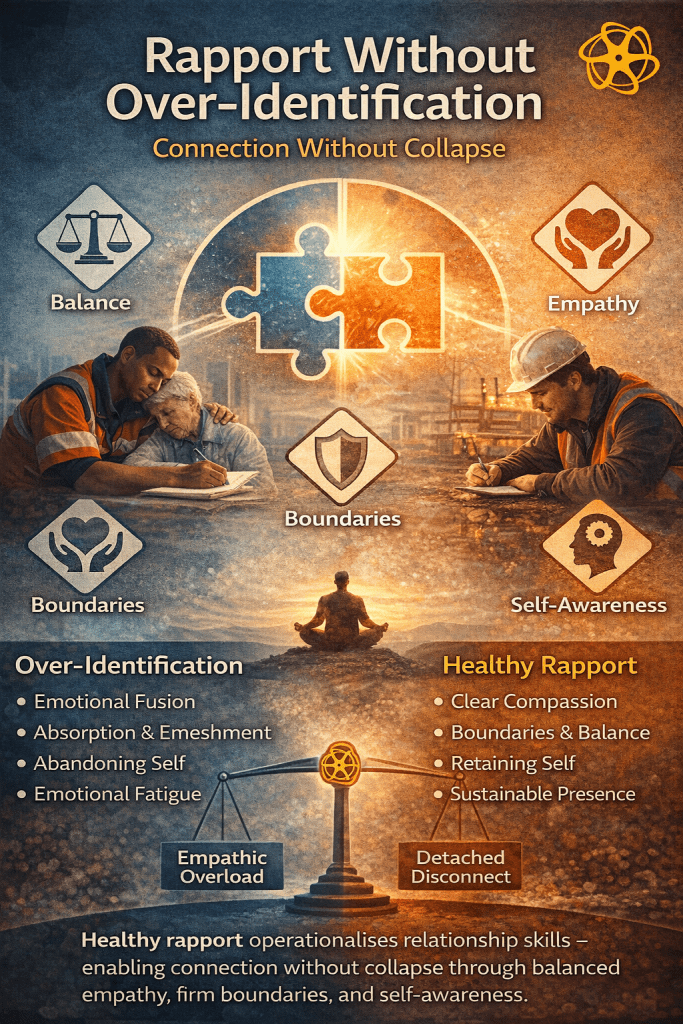
5. Rapport With Boundaries
Healthy rapport includes:
- empathy without merging
- warmth without agreement
- care without control
Boundaries protect both parties.
They preserve clarity and choice.
6. Using Self-Awareness to Maintain Distinction
Effective coaches monitor:
- emotional resonance
- bodily cues
- internal urges to fix or defend
These signals prompt regulation, rather than action.
Awareness restores separation.
7. When Distance Is Misread as Coldness
Boundaried rapport can be misinterpreted as detachment.
In reality, it allows:
- steadier presence
- clearer reflection
- ethical depth
Containment is different from withdrawal.
8. Rapport as a Professional Skill
Rapport matures with:
- supervision
- reflective practice
- experience
- restraint
Mastery shows in how little the coach intrudes, instead of how close they feel.
In Essence
Rapport is far removed from fusion.
It is connection that preserves perspective.
Coaching serves clients best when empathy is paired with clear boundaries and steady presence.
Key Learning Points (KLPs)
- Rapport creates safety, not sameness
- Over-identification blurs judgement
- Emotional merging reduces effectiveness
- Boundaries support ethical coaching
- Self-awareness prevents role drift
- Distance can coexist with warmth
- Mastery preserves distinction
Action Points (APs)
- Notice urges to rescue or agree
- Regulate emotional resonance during sessions
- Use supervision to process overlap
Keywords
rapport in coaching, over-identification, applied wholeness, coaching judgement, professional boundaries, ethical coaching, relational presence, Enasni Connections