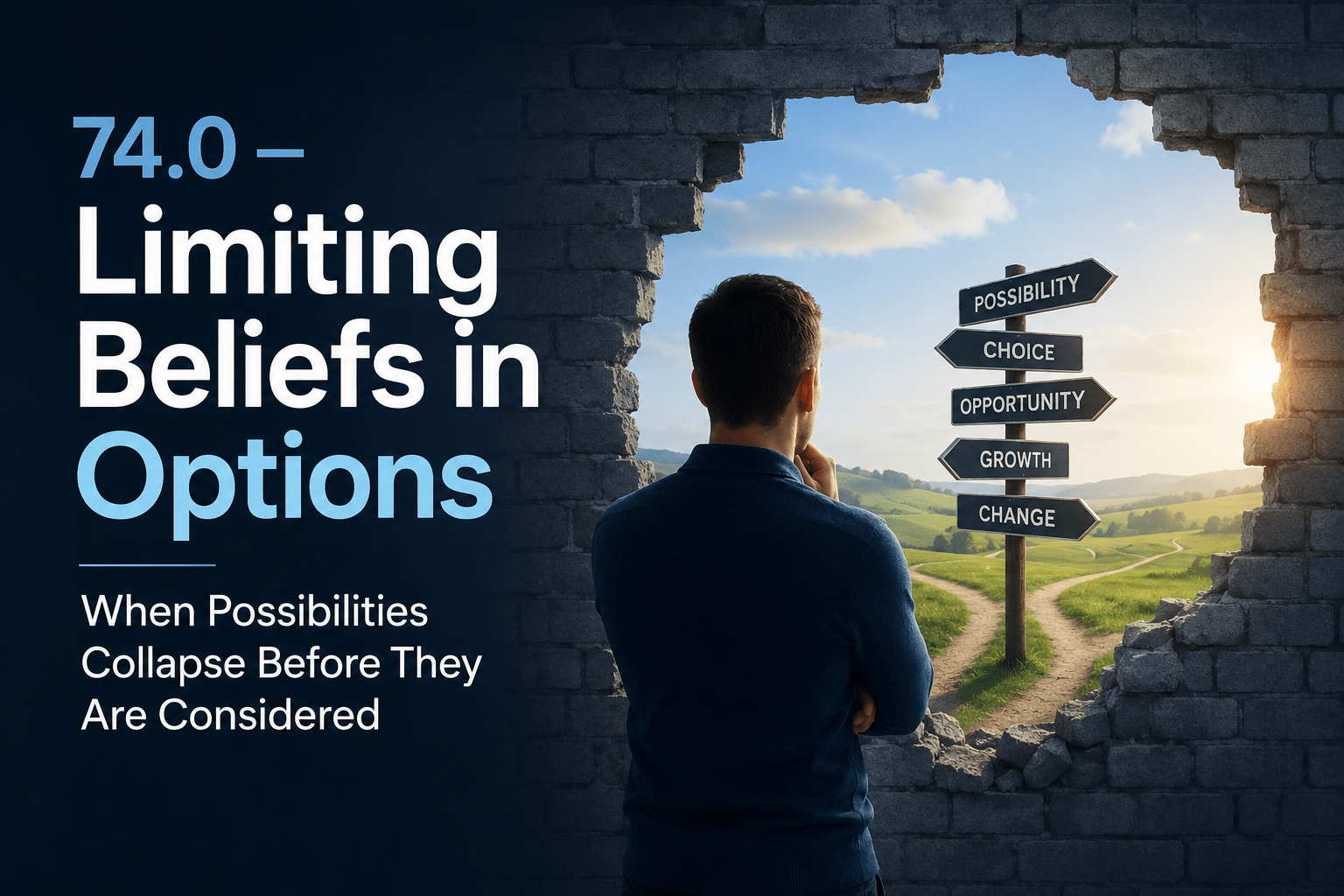
When Possibilities Collapse Before They Are Considered
Limiting beliefs in options matter because choice is far removed from creativity alone, and especially because many people unknowingly eliminate options before conscious evaluation begins.
In coaching conversations, clients often report having “no options.” This is rarely accurate. More often, beliefs have filtered what feels thinkable, safe, or permissible — long before exploration starts.
This post explores how limiting beliefs constrain the field of options from a wholeness perspective.
1. Options Exist Before They Are Noticed
Options are not created by thinking harder.
Options already exist inside you — but access depends on perception.
Creativity and beliefs play a big role here.
Both creative thinking and the evaluation of beliefs heavily involve the prefrontal cortex. The frontopolar cortex is associated with high-level creative thought, while the ventromedial prefrontal cortex (vmPFC) is crucial for evaluating personal, emotional, and religious beliefs.
Beliefs determine:
- what is considered
- what is dismissed instantly
- what feels unrealistic
- what feels forbidden
A belief such as “That wouldn’t work for someone like me” removes options without examination.
2. How Beliefs Collapse the Option Field
Limiting beliefs narrow options by:
- rejecting ideas prematurely
- filtering for safety over possibility
- favouring familiarity over effectiveness
This results in a small, repetitive menu of choices — even in complex situations.
3. “I Have No Options” as a Belief Signal
Statements like:
- “There’s nothing else I can do.”
- “Those are my only choices.”
signal belief activity rather than factual limitation.
The option field has collapsed.
4. Why Generating More Options Often Fails
Simply brainstorming more options can backfire.
When belief remains intact:
- new options feel unrealistic
- energy drops
- dismissal increases
Options must feel permissible, instead of just possible.
Belief determines permission.
5. Coaching Options Safely
Effective coaching expands options by:
- slowing evaluation
- separating generation from judgement
- naming belief-based exclusions
- restoring safety
Questions such as:
- “What feels off-limits here?”
- “What option would you reject immediately?”
reveal belief boundaries gently.
6. The Emotional Signature of Constrained Options
Constrained options often feel:
- heavy
- dull
- repetitive
- urgency-driven
Expanded options bring:
- curiosity
- lightness
- playfulness
Emotion provides feedback on the option field.
7. Small Option Expansion
Large leaps threaten belief structures.
Small expansions:
- introduce novelty safely
- test reality gently
- preserve identity
One additional option can reopen choice.
8. From Constrained Options to Creative Choice
When belief influence is recognised:
- options multiply naturally
- evaluation becomes clearer
- decision-making feels lighter
Choice replaces limitation.
In Essence
Options disappear because belief removes permission rather than because they do not exist.
Coaching restores possibility by expanding perception before demanding decision.
Key Learning Points (KLPs)
- Options exist before conscious evaluation
- Limiting beliefs collapse the option field
- “No options” signals belief activity
- Brainstorming fails when permission is absent
- Safety restores access to options
- Emotion reflects option constraint or expansion
- Small expansions create large shifts
Action Points (APs)
- Notice language that signals collapsed options
- Separate option generation from evaluation
- Explore which options feel forbidden
Keywords
limiting beliefs in options, option generation coaching, applied wholeness, coaching judgement, belief constrained choices, decision making patterns, creative options, Enasni Connections