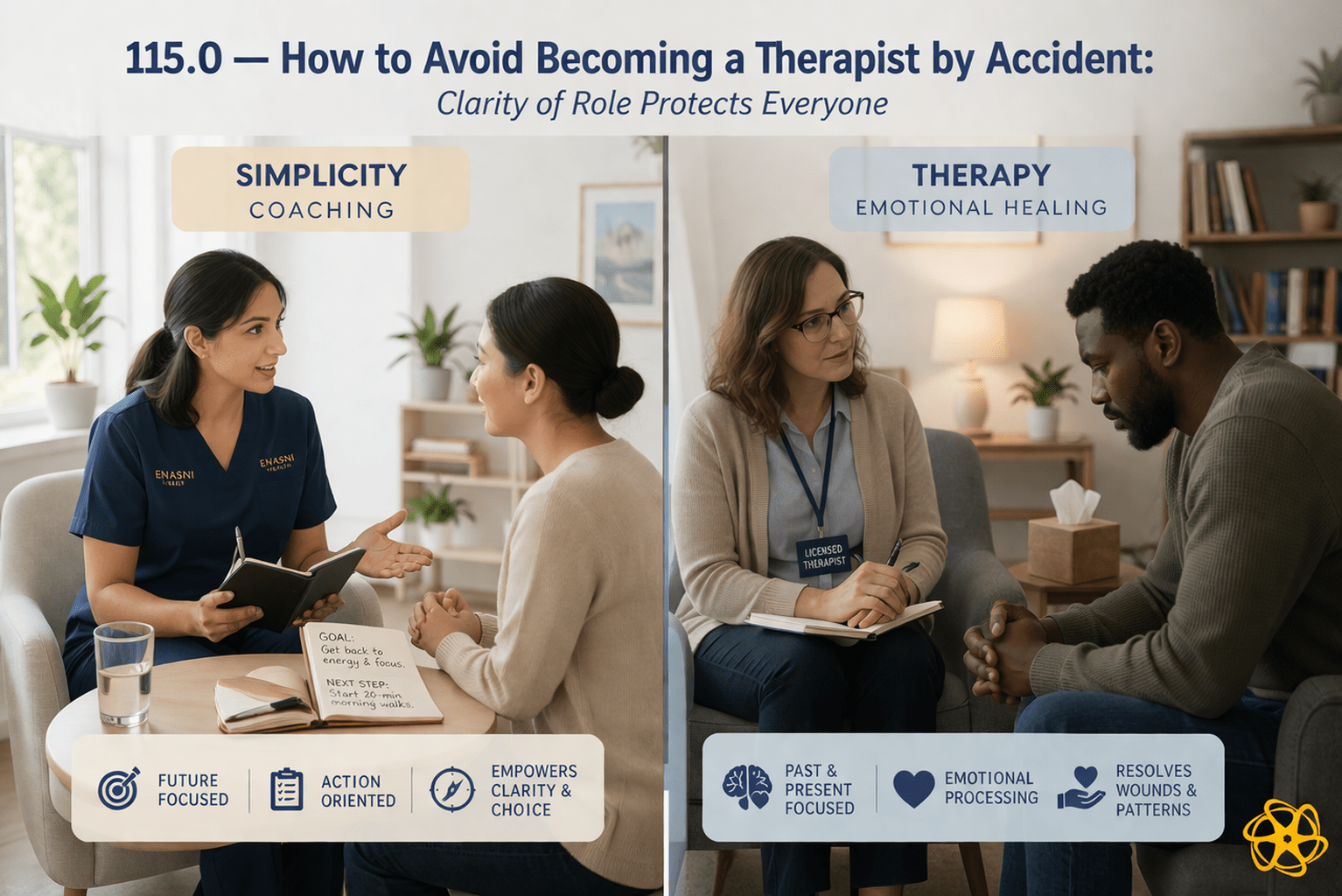
Clarity of Role Protects Everyone
Avoiding accidental therapy matters because good intention is far removed from professional appropriateness, and especially because coaching and therapy serve different functions — even when both involve depth, emotion, and insight.
Many coaches cross boundaries unintentionally. Not through recklessness, but through care, empathy, and a desire to help. Without role clarity, coaching drifts into therapeutic territory, creating ethical risk for both client and coach.
This post restores precision.
1. Why the Line Blurs So Easily
The line blurs because coaching:
- involves emotion
- explores belief
- holds vulnerability
- invites reflection
These overlaps create the illusion that roles are interchangeable.
They are not.
2. The Core Difference in Orientation
Therapy focuses on:
- healing past wounds
- resolving trauma
- treating dysfunction
Coaching focuses on:
- present awareness
- future-oriented choice
- capacity expansion
Time orientation differs.
Purpose differs.
Responsibility differs.
3. Signs Coaching Has Drifted Into Therapy
Indicators include:
- repeated trauma processing
- focus on symptom relief
- emotional catharsis without forward movement
- coach attempting to heal or fix
These are signals to pause — not push.
4. Emotional Holding Without Treatment
Coaches can:
- hold emotion
- name experience
- create safety
Coaches do not:
- process trauma
- diagnose conditions
- interpret pathology
Holding is presence.
Treatment is intervention.
5. Boundaries as Ethical Infrastructure
Clear boundaries define:
- scope of practice
- client responsibility
- referral necessity
Boundaries protect:
- client wellbeing
- coach sustainability
- professional integrity
They are not limitations.
They are structure.
6. When to Pause or Refer
Referral is appropriate when:
- trauma dominates sessions
- emotional regulation is consistently compromised
- progress requires clinical intervention
Referral is not failure.
It is professionalism.
7. Language That Maintains Coaching Frame
Coaches maintain role clarity by using language that:
- emphasises choice
- focuses on meaning and action
- avoids diagnostic interpretation
Language shapes orientation.
8. Mastery Lies in Staying in Role
Coaching mastery includes:
- resisting rescue
- tolerating emotion without fixing
- trusting the coaching process
Staying in role sustains effectiveness.
In Essence
Depth does not require role confusion.
Coaching remains powerful when its purpose is clear.
Professional integrity is maintained by knowing what to hold — and what to refer.
Key Learning Points (KLPs)
- Coaching and therapy serve different purposes
- Emotional depth does not equal therapeutic work
- Role confusion creates ethical risk
- Holding differs from treating
- Boundaries protect all parties
- Referral signals professionalism
- Mastery includes restraint
Action Points (APs)
- Clarify role and scope with clients early
- Monitor sessions for drift indicators
- Build trusted referral pathways
Keywords
coaching vs therapy, ethical coaching boundaries, applied wholeness, coaching judgement, scope of practice, professional integrity, referral in coaching, Enasni Connections