
Wholeness in coaching is the silent force that shapes sustainable growth. It recognises that development is not fragmented but integrated — across mind, body, emotion, and relationship.
Coaching may teach skills non-directively, but wholeness gives them soul. It’s the inner equilibrium that allows action without frenzy, and compassion without collapse.
Wholeness is less about perfection. It is more about the quiet agreement between mind, body, and spirit that says, I am enough to begin.
Why Wholeness in Coaching Sustains Growth
Wholeness in coaching prevents fragmentation. Rather than isolating performance from identity or strategy from emotion, it integrates the full human system into the developmental process.
True growth happens when reflection, regulation, and ethical awareness move together. This is why every serious practice is grounded in a professional code of ethics, ensuring that development remains responsible, safe, and aligned with the trust placed in the coaching relationship.
Wholeness also deepens through the coach’s commitment to continuous development. Ongoing supervision, study, and reflective practice expand the capacity to hold complexity without reducing the client to a single dimension.
When wholeness guides coaching, growth becomes sustainable. Insight connects with action, compassion balances challenge, and development unfolds without fragmentation.
Long-term research such as the Harvard Study of Adult Development shows that integrated wellbeing — across relationships, emotional regulation, and purpose — predicts sustained human growth over decades.
The Nature of Wholeness
Wholeness is the recognition that growth does not occur in isolated compartments. Human experience unfolds across interconnected dimensions that influence one another continuously. Thought shapes emotion, emotion shapes behaviour, behaviour shapes relationship, and relationship shapes the environment in which development takes place. Wholeness in coaching therefore honours the full system of the person rather than focusing on a single aspect of performance.
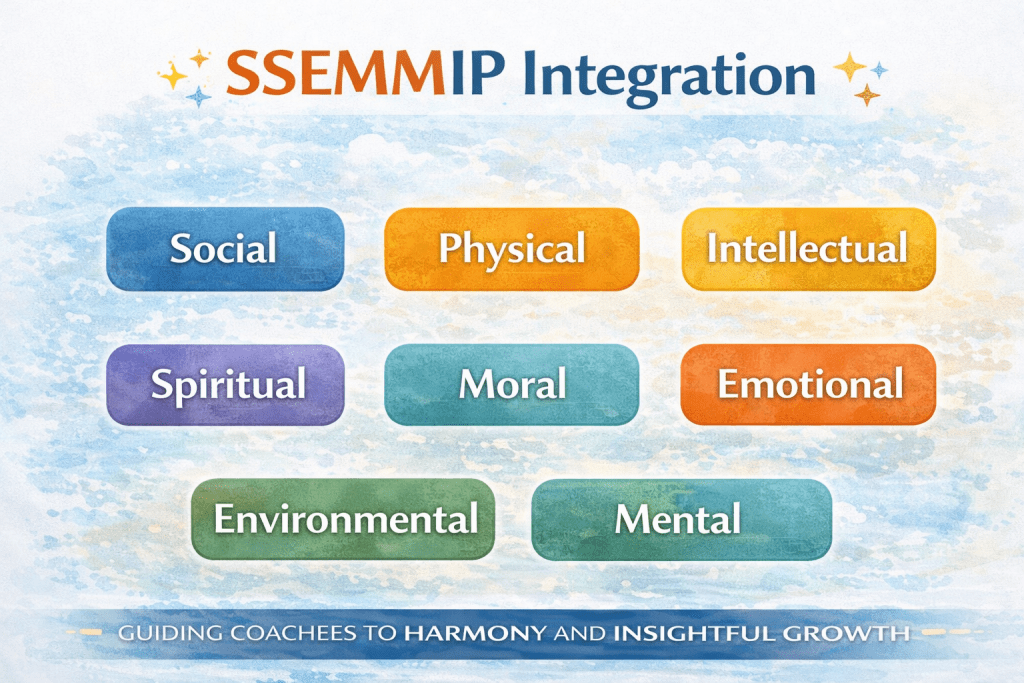
Within the Enasni framework, this integration becomes clearer through the SSEEMMIP integration model, which explores how spiritual, social, emotional, environmental, mental, material, intellectual, and physical domains interact to shape lived experience. Growth becomes more stable when these dimensions are acknowledged and aligned rather than addressed in isolation.
Wholeness in coaching therefore invites the coach to listen beyond surface goals. It encourages attention to context, regulation, meaning, and relational dynamics. When these elements move into alignment, development no longer feels forced; it begins to unfold with coherence and sustainability.
Wholeness is what remains when nothing is missing — not because everything is ideal, but because nothing essential is denied. It’s a harmony of presence: thinking clearly, feeling deeply, acting consciously.
Stress fractures that harmony; awareness restores it.
In our coaching, the aim is not to eliminate stress, but to distinguish — to keep the good stress that drives, and dissolve the bad stress that drains.
A Return to Balance
Wholeness is not found; it’s rebuilt through choice.
Tiny, consistent shifts — breathing slower, listening inward, naming truth — begin to realign the system. Over time, this creates coherence: the state where energy, thought, and intention move in one direction.
Balance in coaching is far removed from passive stillness; balance is dynamic alignment. Wholeness in coaching invites awareness across physical regulation, emotional clarity, intellectual discernment, relational presence, and purposeful action. When these dimensions move together, growth becomes sustainable rather than reactive.
A return to balance allows the client to reconnect with internal signals that guide healthy adaptation. Even arguably more beneficial is the return of consistent dynamic equilibrium of the client’s regulated nervous system.
Bad stress begins to shift from chaotic pressure into meaningful challenge and good stress. Energy once spent managing fragmentation becomes available for insight, creativity, and disciplined action.
Wholeness in coaching therefore restores continuity between what a person thinks, feels, and does. This alignment strengthens resilience, deepens self-trust, and enables progress that remains steady even when circumstances become complex or demanding.
Key Learning Points
- Wholeness is the foundation of sustainable growth and self-leadership.
- It arises from alignment, not perfection.
- Coaching supports wholeness by helping clients transform stress into awareness.
- Tiny, intentional shifts can restore balance and energy flow.
- A coherent inner state improves clarity, decision-making, and peace.
Action Points
- Identify one area of imbalance and apply a small, daily shift.
- Practise conscious breathing or reflective stillness before major decisions.
- Approach stress as information — not the enemy.
In Essence
Wholeness is different from a goal; it is a remembering.
When we as a person reconnect to our centre, life’s movement becomes less about survival and more about rhythm.
At Enasni, this is where coaching and healing meet — where the human learns to flow again.