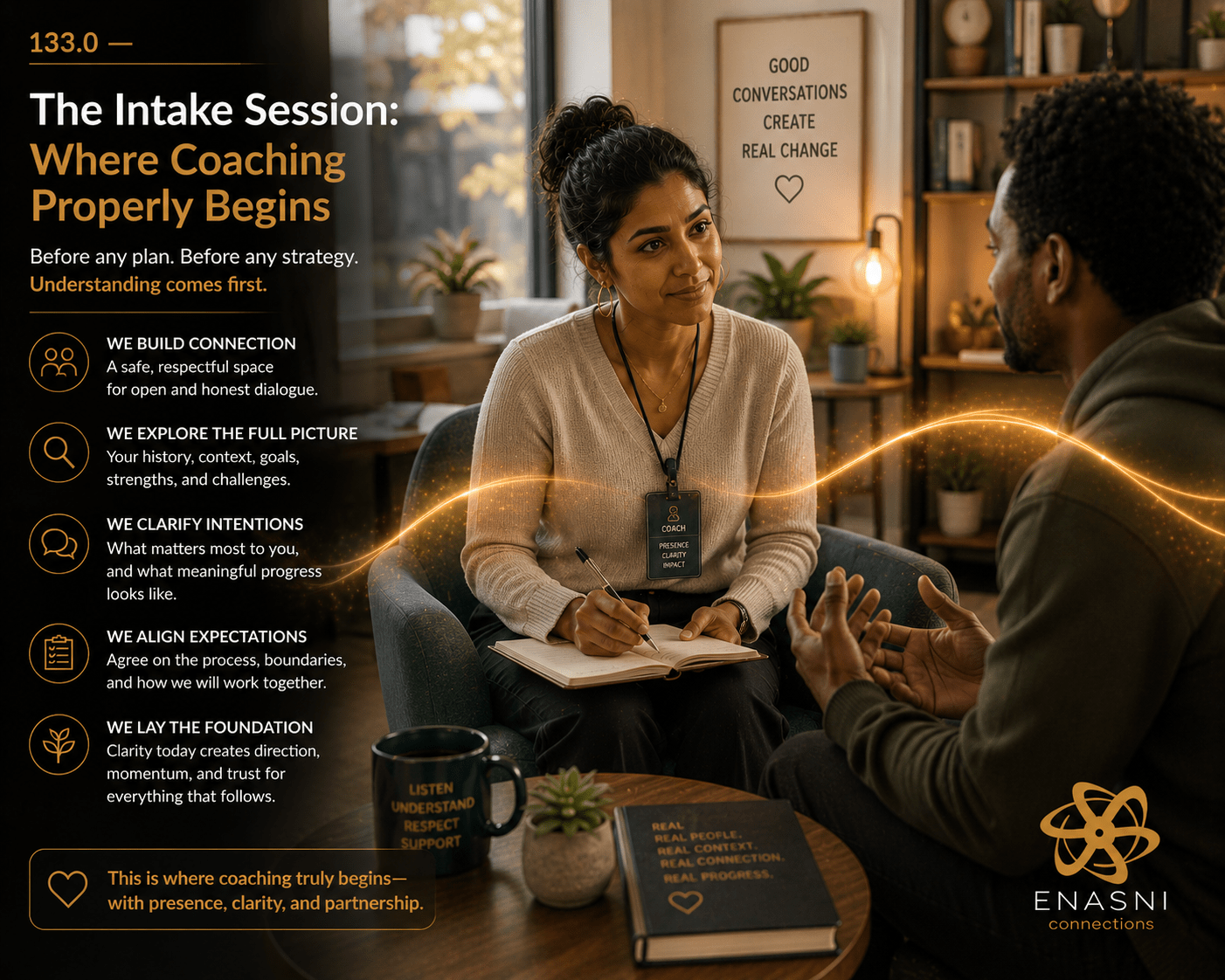
Where Coaching Properly Begins
The intake session matters because momentum is far removed from clarity on its own, and especially because the first formal session establishes safety, authority, orientation, and responsibility for the entire coaching relationship.
This post clarifies what the intake session is for, how it is structured, and why it is deliberately longer, slower, and more comprehensive than regular sessions, ensuring coaching begins on solid ground from a wholeness perspective.
What the Intake Session Is
The intake session is the first formal coaching session.
It is typically:
- around 90 minutes
- information-rich
- relationally grounding
- structurally orienting
This is not a “normal” session.
It is a foundation-setting session.
The Purpose of the Intake Session
The intake session exists to:
- gather essential information
- establish confidentiality and safety
- clarify roles and commitments
- orient the client to how coaching works
- assess readiness and capacity
- build initial rapport
Without this session, coaching lacks a stable base.
Seven Core Focus Areas of the Intake Session
1. Information and Contact Details
This includes:
- full name
- date of birth
- contact information
Where relevant and appropriate, additional health-related details may be gathered with permission, not for treatment, but for duty-of-care awareness.
The purpose is preparedness — not intrusion.
2. Clarifying Role and Commitment
The coach clarifies:
- what coaching is
- what coaching is not
- the coach’s role
- the client’s responsibility
This prevents:
- unrealistic expectations
- dependency
- role confusion
Commitment is mutual and explicit.
3. Confidentiality and Safety
Confidentiality is explained clearly and reinforced.
This includes:
- what is confidential
- when confidentiality may be broken
- how information is stored
- how safety overrides privacy when required
Confidentiality cannot be assumed.
It must be named and held.
4. Client Agency and Control
Clients are reminded:
- they are in charge
- they choose how long coaching continues
- they can pause, question, or stop
Agency is restored early.
Coaching works only when choice is explicit.
5. Permission to Interrupt and Refocus
The coach seeks permission to:
- interrupt when necessary
- redirect conversation
- bring focus back to goals
This is framed as:
- value protection
- time respect
- goal integrity
Permission prevents later friction.
6. Explaining Session Structure
A standard session structure is outlined:
- Review previous actions
- Set session focus or goal
- Explore current reality
- Generate options
- Agree actions
- Summarise agreements
This creates predictability and reduces anxiety.
Structure supports flow.
7. Understanding the Client’s World
The intake session includes history taking, scaled appropriately to the length of engagement.
For longer-term coaching, this may include:
- major life events
- achievements
- obstacles overcome
- values and priorities
- professional background
- support systems
- orientation to time (past, present, future)
- self-perception
Clients are informed:
- answers are optional
- questions can be clarified
- information is used to improve effectiveness
The principle is simple:
The more context the coach has, the more precise the coaching can be.
Two Complementary Approaches
A. Detailed History Taking
Used when:
- seeking major life change
- engaging in longer-term work
This builds a rich internal map of the client.
B. “Where Are You Now?” Mapping
Used when:
- working short-term
- addressing immediate dissatisfaction
This explores:
- tolerations
- frustrations
- desires
- “shoulds”
This method converts dissatisfaction into future-oriented goals.
Questions That Matter
Effective intake questions include:
- What have been your most fulfilling accomplishments?
- What has made you feel powerful or successful?
- What have you had to overcome?
- What is most important to you right now?
- In one sentence, who are you?
These questions are not data collection.
They are identity mirrors.
What the Coach Is Doing Internally
Throughout the intake, the coach:
- listens actively
- tracks patterns
- notices emotional tone
- asks open-ended follow-ups
- resists premature problem-solving
The intake is not about fixing.
It is about seeing clearly.
Keeping the Client Informed
Clients are told:
- what is happening
- why it is happening
- how the time is being used
Transparency builds trust.
Mystery creates distance.
In Essence
The intake session is where coaching earns its right to continue.
It establishes:
- safety
- clarity
- structure
- agency
- shared understanding
When done well, everything that follows becomes easier, cleaner, and more effective — because the foundation can carry the work.
Key Learning Points (KLPs)
- The intake session is a formal foundation-setting space
- Longer duration supports depth and safety
- Confidentiality must be explicitly explained
- Client agency is reinforced early
- Permission protects focus and value
- Structure reduces anxiety
- Context enables precision
Action Points (APs)
- Design intake sessions differently from regular sessions
- Make confidentiality and agency explicit
- Explain structure and purpose throughout the session
Keywords
intake session coaching, coaching intake process, first coaching session, applied wholeness coaching, coaching readiness assessment, ethical coaching practice, client onboarding, Enasni Connections