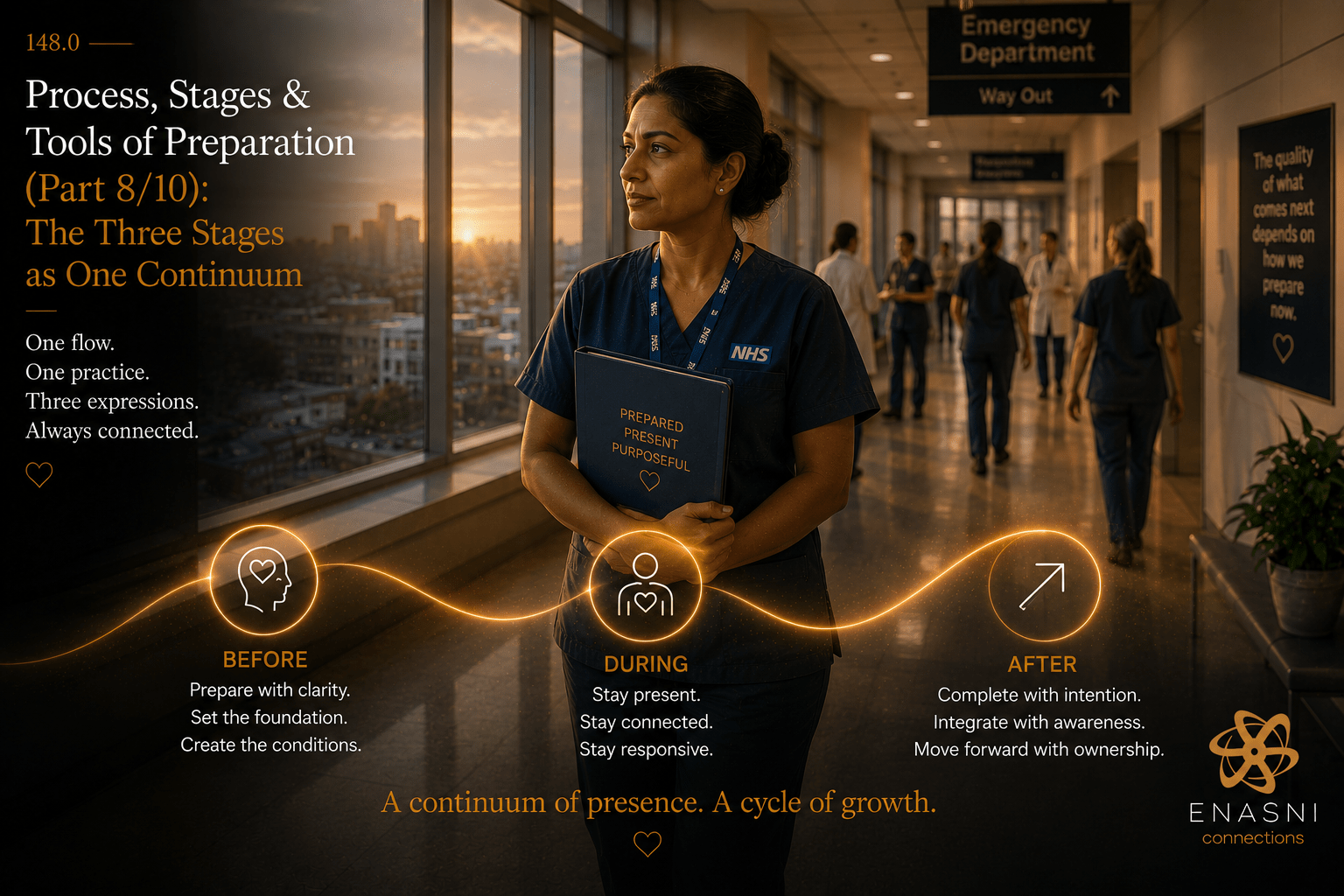
The Three Stages as One Continuum
Preparation matters because separation is far removed from coherence on its own, and especially because long-, medium-, and short-term preparation only work when understood as a continuous system rather than isolated acts.
This post reconnects the three stages of preparation into one living flow — long-term development, medium-term attunement, and short-term presence — showing how each supports the others so the coach arrives clear, regulated, and useful from a wholeness perspective.
Why the Stages Must Be Integrated
Treating preparation stages as separate tasks creates friction.
When fragmented:
- long-term learning becomes abstract
- medium-term review becomes cognitive overload
- short-term presence feels forced
When integrated:
- learning informs judgement
- attunement guides attention
- presence becomes natural
The stages are not sequential steps.
They are layers of readiness.
Stage One Revisited: Long-Term as the Ground
Long-term preparation forms the base layer.
It includes:
- ongoing learning
- skill development
- exposure to ideas and perspectives
- refinement of judgement
This layer answers:
What am I bringing to the table as a professional?
Without this foundation, later stages collapse under pressure.
Stage Two Revisited: Medium-Term as Orientation
Medium-term preparation sits on top of the foundation.
It involves:
- brief review of client context
- remembering who this client is
- recalling goals, gains, and challenges
- noticing patterns without rehearsing solutions
This stage answers:
Who am I meeting, and where are they in their journey right now?
It is remembrance, not rumination.
Stage Three Revisited: Short-Term as Presence
Short-term preparation is the final layer.
It is internal.
It includes:
- pausing
- regulating breath and attention
- releasing distraction
- re-centering on the client
This stage answers:
Am I available — right now — to guide rather than perform?
Presence completes preparation.
Why Presence Makes Everything Else Irrelevant
A key realisation surfaces clearly:
It doesn’t really matter what they want to know.
My job is to guide them to where they want to be.
When presence is established:
- content becomes secondary
- technique becomes responsive
- confidence stabilises
The coach steps out of the centre.
The client steps forward.
Preparation Is Not Perfection
Preparation does not require:
- alarms
- rigid routines
- perfect conditions
Real practice includes:
- unexpected timing
- imperfect starts
- adapting on the fly
What matters is the ability to settle into role, not the absence of disruption.
Letting Go of Self-Inclusion
A subtle but critical shift occurs here.
Preparation includes removing the self from the equation:
- personal performance
- self-judgement
- outcome attachment
The coach becomes a guide, not a participant.
This lightness increases effectiveness.
When All Three Stages Are Active
When long-, medium-, and short-term preparation align:
- confidence is quiet
- attention is wide
- judgement is responsive
- effort decreases
- impact increases
Preparation stops being something done before coaching.
It becomes how coaching is lived.
In Essence
The three stages of preparation are not separate skills.
They are one integrated orientation.
When learning, attunement, and presence operate together, the coach arrives ready — not because everything is known, but because nothing essential is being carried unnecessarily.
Key Learning Points (KLPs)
- Preparation stages form a continuum
- Long-term preparation builds professional ground
- Medium-term preparation orients to the client
- Short-term preparation establishes presence
- Presence outweighs content knowledge
- Preparation does not require perfection
- Removing self-focus increases effectiveness
Action Points (APs)
- Review preparation as an integrated system
- Reduce over-emphasis on any single stage
- Practise settling into role regardless of conditions
Keywords
three stages of preparation coaching, integrated coaching preparation, applied wholeness coaching, coach readiness, professional coaching presence, preparation continuum, coaching judgement, Enasni Connections