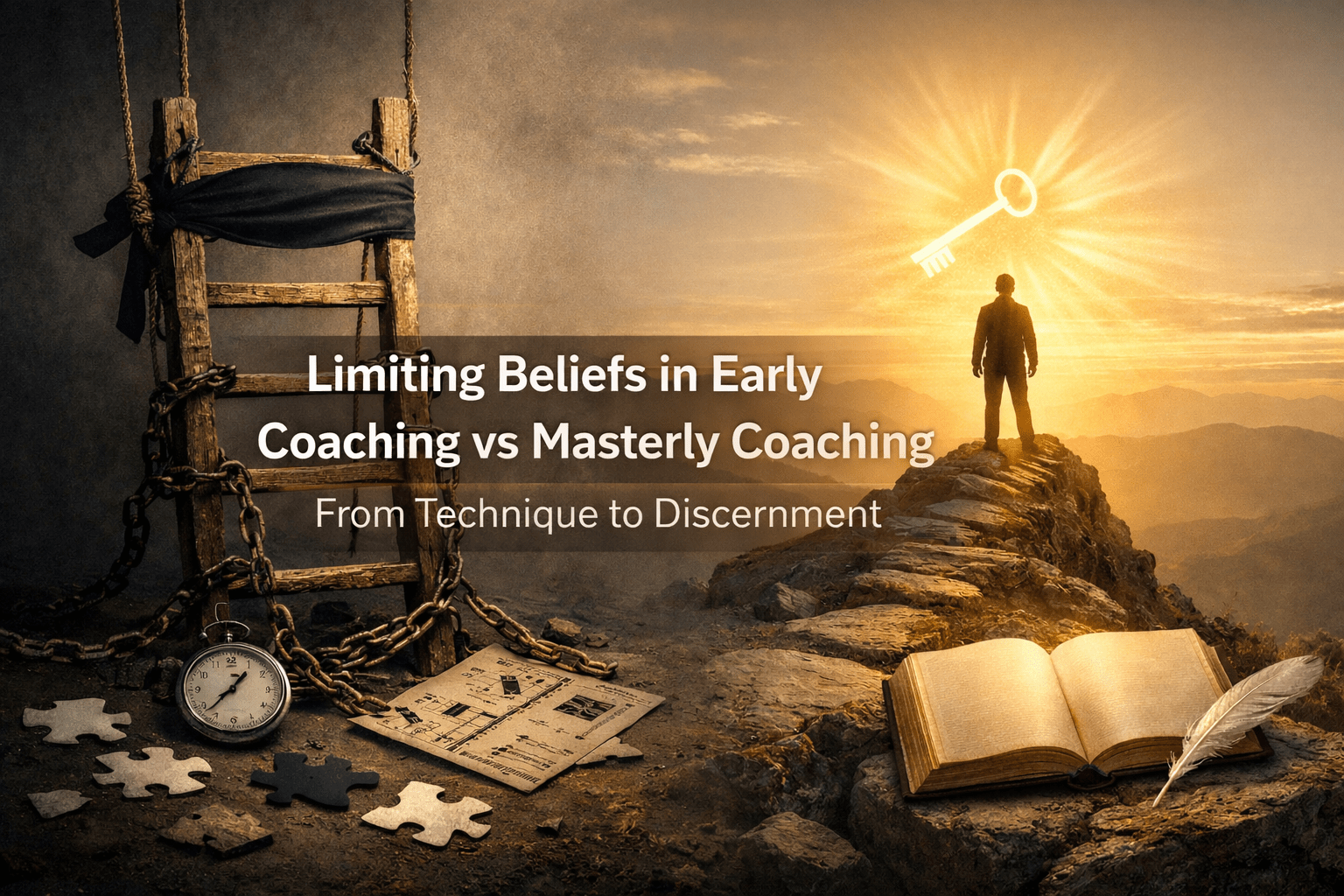
From Technique to Discernment
Limiting beliefs appear at every stage of coaching practice. What changes is not their presence, but rather how they are recognised, held, and engaged.
Early coaching and masterly coaching fail to differ in intention. They do differ successfully however, in judgement, pacing, and depth of perception.
This post clarifies that progression from a wholeness perspective.
1. How Early Coaching Approaches Limiting Beliefs
In early coaching practice, limiting beliefs are often treated as:
- obstacles to overcome
- statements to challenge
- thoughts to reframe
Common patterns include:
- identifying the belief quickly
- challenging it directly
- offering alternative perspectives
- moving swiftly to action
This approach reflects good training — and limited experience.
It works when belief is light and cognitive.
2. Where Early Approaches Begin to Strain
Early-stage belief work can misfire when:
- belief is identity-linked
- emotional charge rises
- shame becomes active
- behaviour does not shift
At this point, pushing belief change increases resistance.
The coach may interpret this as client reluctance rather than depth misjudgement.
3. How Masterly Coaching Recognises Belief
Masterly coaching recognises belief through:
- subtle language cues
- emotional shifts
- somatic signals
- pattern repetition
Belief rushed into focus seldom works.
It ought to be located first before it is engaged. Imagine stumbling in the dark (unknown state), then bumping into an unknown object (revealed belief), and then using your hands and sense of touch to try and make sense of the object to recognise it – what do you do?
We do what babies do, shake it and listen to its sound, feel the surrounding area to find out if there is more, notice what you notice e.g texture, size, hardness, temperature etc. well locating belief is much of the same and using the 4 listed techniques above are a sure fire way to locate the specific belief in order to engage it fully.
4. Mastery Prioritises Safety Over Speed
Where early coaching values momentum, masterly coaching values:
- safety
- containment
- timing
The master coach understands that belief change without safety destabilises identity.
Slowing down is not avoidance.
It is precision.
5. Challenging Belief in Masterly Coaching
In masterly practice, belief is rarely “challenged.”
Instead, it is:
- explored
- contextualised
- gently tested through experience
Reality, rather than persuasion, does the work.
Beliefs soften when they no longer need to protect. They were born as protectors to begin with. How did you feel when someone you trusted told you, “I believe in you?”.
Coincidence?
I think not.
6. Action Emerges Differently
Early coaching often moves quickly to action.
Masterly coaching allows action to emerge when:
- belief has loosened
- regulation is stable
- choice feels genuine
Action follows alignment, rather than instruction.
7. What Mastery Looks Like in Practice
Mastery is visible when:
- less is said, more is noticed
- silence is used intentionally
- belief shifts feel quiet rather than dramatic
- clients report ease rather than effort
Change stabilises because it is integrated.
8. The Developmental Arc
Early coaching is necessary.
It builds:
- confidence
- structure
- competence
Masterly coaching emerges through:
- experience
- reflection
- restraint
Both belong, both necessary – a world where more good exists than bad needs more professional coaches. Simultaneously the sooner one receives coaching, the better the outcome for trapped beliefs.
In Essence
Limiting beliefs are far removed from being handled better by doing more.
They are indeed handled better by seeing more.
Mastery is different from speed — it is akin to discernment.
Key Learning Points (KLPs)
- Early coaching treats beliefs cognitively and directly
- This works when belief is light and accessible
- Deeper belief requires safety and pacing
- Masterly coaching locates belief before engaging it
- Speed is replaced by discernment
- Action emerges from alignment, not instruction
- Mastery develops through experience and restraint
Action Points (APs)
- Slow belief work when emotional charge increases
- Observe language, emotion, and behaviour together
- Allow belief change to emerge rather than forcing it
Keywords
limiting beliefs early vs masterly coaching, coaching mastery, applied wholeness, coaching judgement, belief work development, identity safe coaching, professional growth, Enasni Connections