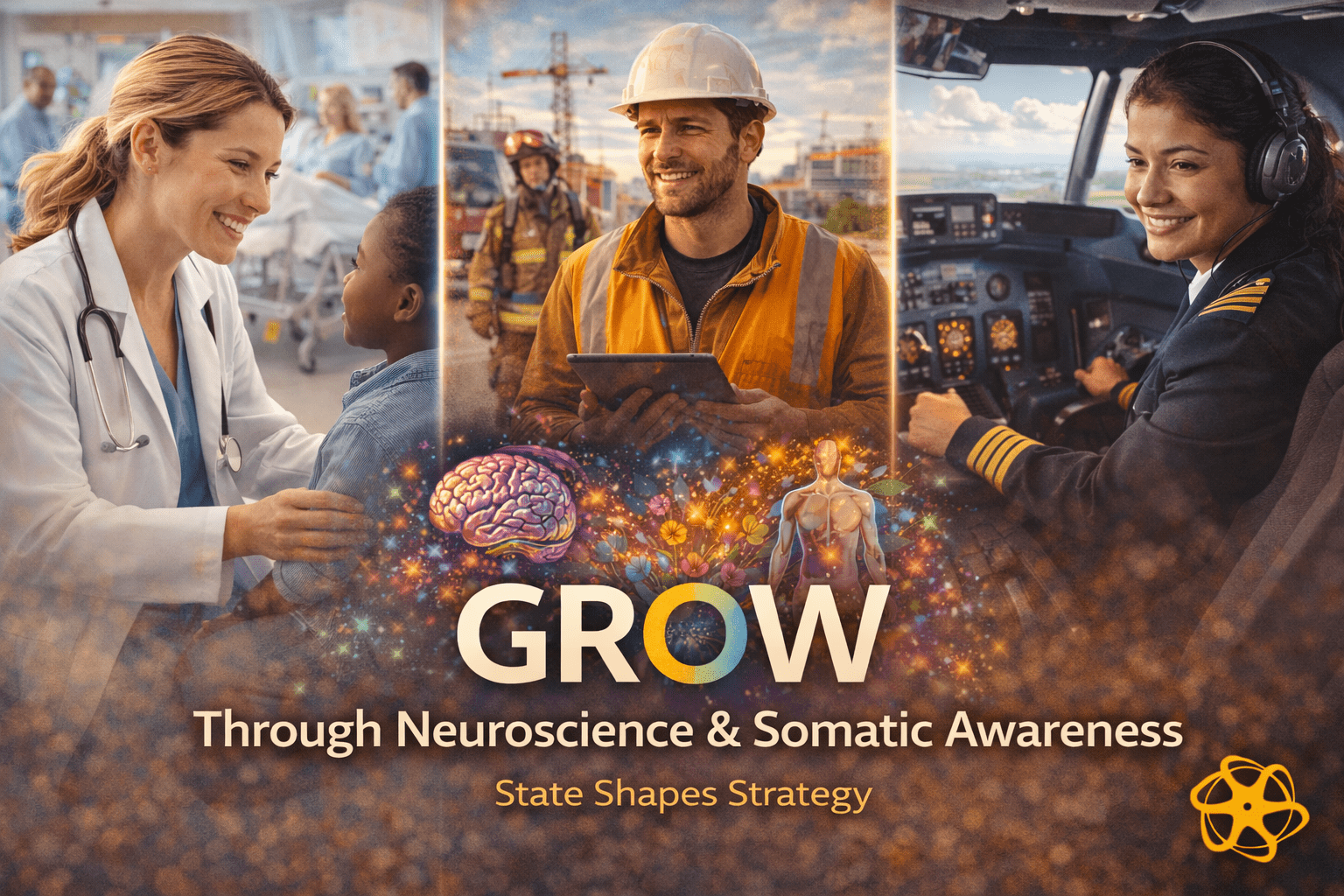
State Shapes Strategy
GROW through neuroscience and somatic awareness matters because cognition is far removed from capacity on its own, and especially because no stage of GROW functions accurately inside a dysregulated nervous system.
When the body is under threat, perception narrows, options collapse, and action becomes survival-based. This post reframes GROW as a state-dependent process, guided by nervous-system intelligence and embodied awareness from a wholeness perspective.
1. Why GROW Is State-Dependent
Every stage of GROW is filtered through physiological state.
When regulation is low:
- goals become defensive
- reality feels overwhelming
- options disappear
- action triggers avoidance
When regulation is present:
- perception widens
- curiosity returns
- choice stabilises
State precedes strategy.
2. Goal Through a Neuroscience Lens
In dysregulated states, goals tend to be:
- urgent
- rigid
- avoidance-driven
Through regulation, goals become:
- flexible
- values-aligned
- capacity-aware
Somatic cues (tightness, agitation, collapse) reveal whether a goal is emerging from threat or coherence.
3. Reality Through the Nervous System
Reality is perceived, not objective.
Neuroscience shows:
- threat narrows attention
- safety broadens perception
Somatic awareness reveals:
- what feels heavy
- what feels activating
- what feels stabilising
Coaching reality includes how the body experiences circumstances, not just how the mind describes them.
4. Options and Neuroplasticity
Options require cognitive flexibility.
Flexibility increases when:
- breathing slows
- muscle tension reduces
- emotional charge settles
Somatic regulation literally increases access to alternative pathways.
Without regulation, “no options” feels true.
5. Way Forward and Capacity Signals
Action fails when it exceeds capacity.
Somatic signals such as:
- dread
- collapse
- agitation
indicate overload, not lack of motivation.
Neuroscience-informed coaching designs actions that:
- expand capacity gradually
- respect recovery cycles
- avoid threat escalation
6. Bottom-Up Before Top-Down
Neuroscience distinguishes:
- bottom-up processes (body → brain)
- top-down processes (brain → body)
Under stress, bottom-up regulation is required first.
Coaching that relies only on cognition misses this order.
7. Somatic Awareness as Diagnostic Tool
Somatic awareness:
- identifies readiness
- reveals hidden resistance
- prevents misinterpretation
The body provides data the mind cannot access directly.
8. GROW as a Regulated Loop
Through neuroscience, GROW becomes:
- iterative
- paced
- responsive
Coaching may return to regulation at any stage.
This is intelligence, rather than interruption.
In Essence
GROW does not fail due to poor questions.
It fails when the nervous system is ignored.
Neuroscience and somatic awareness restore GROW as a capacity-aligned, sustainable process.
Key Learning Points (KLPs)
- GROW is state-dependent
- Dysregulation distorts all GROW stages
- Goals emerge from threat or coherence
- Perception of reality shifts with regulation
- Options require nervous-system flexibility
- Capacity signals guide effective action
- Regulation precedes strategy
Action Points (APs)
- Assess nervous-system state before progressing
- Use somatic cues to evaluate readiness
- Design actions that expand capacity gradually
Keywords
GROW neuroscience, somatic coaching, applied wholeness, nervous system regulation, coaching judgement, state dependent coaching, sustainable change, Enasni Connections