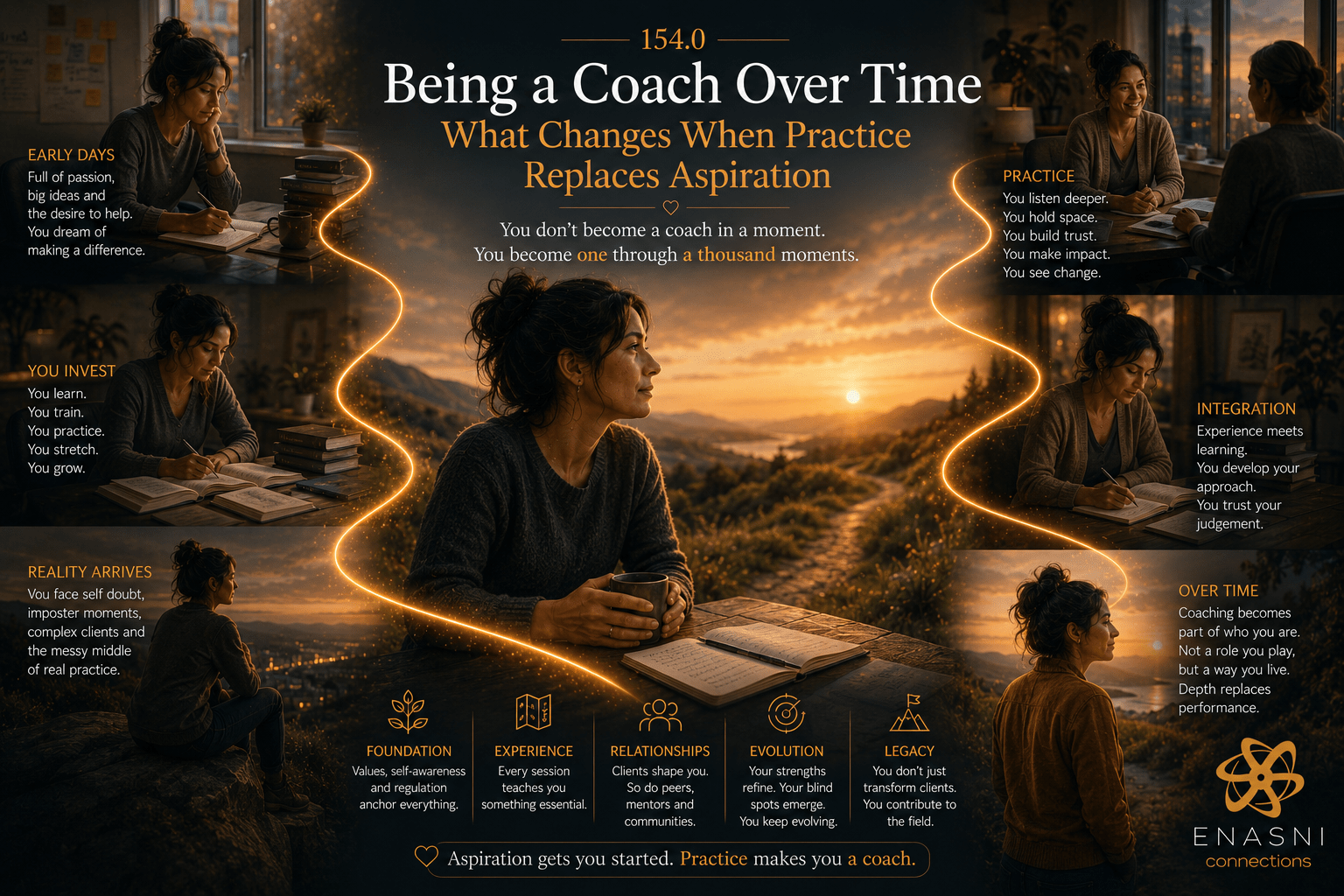
What Changes When Practice Replaces Aspiration
Being a coach over time matters because competence is far removed from maturity on its own, and especially because the work changes the practitioner as much as it supports the client.
This post explores what actually evolves as years pass in coaching practice — how confidence stabilises, restraint deepens, judgement sharpens, and wholeness becomes less performative and more lived from a wholeness perspective.
Early Practice: Effort, Intensity, and Self-Awareness
In the early stages, coaching often feels effortful.
Common experiences include:
- preparing excessively
- relying heavily on tools and models
- over-questioning
- seeking reassurance through technique
- measuring success by visible outcomes
This phase is not wrong.
It is developmental.
Effort is a bridge to fluency.
The Shift From Doing to Discerning
Over time, something subtle changes.
The coach begins to:
- intervene less
- listen more broadly
- tolerate silence
- trust the client’s process
- abandon the need to “add value” constantly
Judgement starts to replace activity.
Not because the coach knows more — but because the coach knows when not to act.
Confidence Without Performance
Mature confidence looks different from early certainty.
It is quieter.
It shows up as:
- steadiness rather than urgency
- curiosity rather than certainty
- presence rather than persuasion
There is less attachment to outcomes.
Sessions are no longer performances.
They are encounters.
Pattern Recognition Replaces Scripted Flow
With exposure comes pattern recognition.
Over time, coaches begin to notice:
- recurring themes across clients
- familiar avoidance patterns
- predictable turning points
- moments where pressure escalates
This does not lead to formulaic responses.
It leads to earlier, cleaner noticing.
The coach sees what is happening without rushing to label it.
Boundaries Strengthen With Time
Boundaries become firmer — and kinder.
Not because rules increase, but because clarity does.
Experienced coaches:
- say no more easily
- end relationships when appropriate
- recognise dependency early
- protect time and energy
Boundaries stop feeling defensive.
They start feeling protective of the work itself.
Identity Stabilises
Early coaching identity is often provisional.
Questions surface:
- Am I doing this right?
- Am I good enough?
- Do I sound like a coach?
Over time, identity settles.
The coach stops trying to sound like anyone else.
Practice becomes congruent with personality.
Authenticity replaces imitation.
Emotional Load Is Carried Differently
The emotional content of coaching does not reduce.
What changes is how it is held.
With time:
- emotional contagion reduces
- over-identification softens
- empathy becomes steadier
- supervision is used proactively
The coach learns to be with intensity without absorbing it.
Learning Becomes Selective
Early learning is broad.
Later learning is selective.
Experienced coaches:
- read with discernment
- integrate slowly
- discard freely
- prioritise supervision and reflection
Learning stops being about growth through accumulation.
It becomes growth through refinement.
Mistakes Become Teachers, Not Threats
Over time, mistakes:
- lose their charge
- gain informational value
- prompt reflection rather than shame
Judgement sharpens not because errors disappear — but because response to error matures.
Repair becomes a skill.
Why Time Cannot Be Skipped
There is no shortcut to this evolution.
Time provides:
- exposure
- repetition
- failure
- repair
- humility
No model replaces lived practice.
No framework substitutes experience.
In Essence
Being a coach over time is not about becoming exceptional.
It is about becoming reliable, coherent, and trustworthy — to clients, to the work, and to oneself.
Wholeness emerges not through intensity, but through integration.
Key Learning Points (KLPs)
- Coaching maturity develops through exposure
- Judgement replaces over-activity
- Confidence becomes quieter over time
- Boundaries strengthen naturally
- Identity stabilises with congruence
- Emotional load is held more cleanly
- Learning becomes selective and refined
Action Points (APs)
- Reflect on how practice has already shifted
- Notice where less effort creates more impact
- Normalise development as a long arc
Keywords
being a coach over time, coaching maturity, professional judgement development, applied wholeness coaching, coaching identity, long term coaching practice, coaching confidence evolution, Enasni Connections